


Eco-friendly hotel cleaning: how to set it up
Published on
5 min read
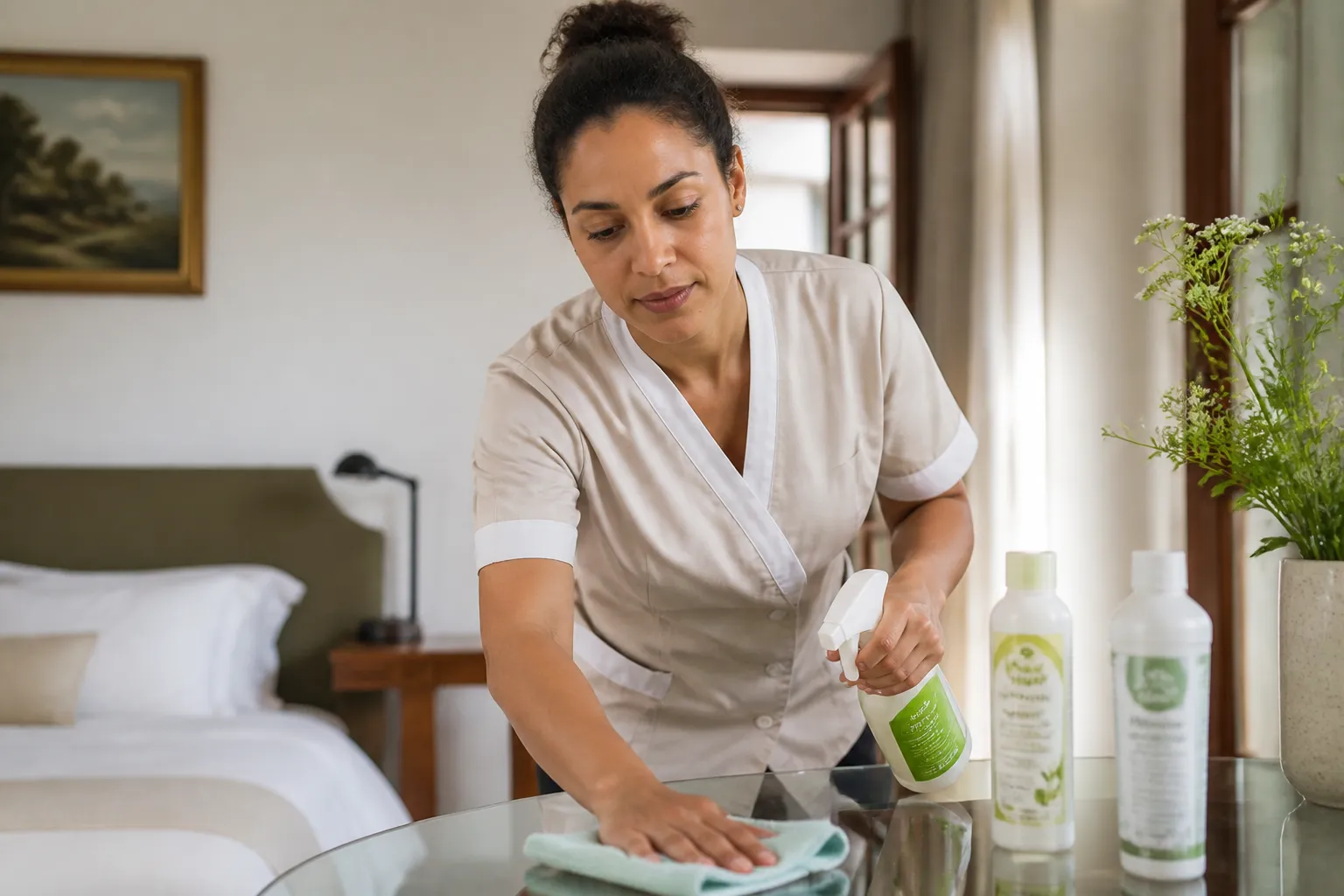
Eco-friendly hotel cleaning is no longer a niche choice: more and more guests, especially international ones, consider a property’s environmental impact a decision criterion on a par with price or location.
Contents
- What “eco-friendly cleaning” actually means
- Ecolabel-certified detergents
- The role of microfibre
- Low-impact equipment
- The real costs of an eco transition
- How to communicate it to guests, without overdoing it
- Training staff on the new standard
- Where to start first
- Common mistakes in an eco transition
- Measuring the results, not just the intentions
- An investment that lines up with market demand
What “eco-friendly cleaning” actually means
Eco-friendly cleaning is not just about swapping one product for another labelled “green”: it covers the choice of detergents, correct dosing, the tools used and how waste from the service is managed. A hotel that buys certified detergents but keeps dosing them “by eye”, without a controlled dispensing system, is simply shifting the problem rather than genuinely cutting its overall environmental impact. Waste management deserves particular attention: separating packaging correctly, choosing refillable containers over single-use ones, and disposing of used cloths and mop heads properly all count toward the same overall footprint as the products themselves.
Ecolabel-certified detergents
Ecolabel-certified detergents for hospitality businesses guarantee verified criteria on biodegradability and lower environmental impact, with performance that in most cases is comparable to conventional detergents. The certification is also something you can communicate to guests, not just an internal choice: many Tuscan hotels display a short note in-room or at reception about the certified products used, a detail attentive guests notice and appreciate.
The role of microfibre
Microfibre for professional cleaning cuts water and chemical product use compared with traditional cloths, thanks to its ability to capture dust and dirt mechanically. It is probably the simplest and cheapest way to make a cleaning service more sustainable, with no loss of effectiveness: a good-quality microfibre cloth lasts hundreds of washes, compared with just a few dozen for a traditional cloth, cutting replacement costs over the medium term too.
Low-impact equipment
Beyond products, equipment also contributes to the environmental impact of the service: low-energy vacuum cleaners, trolleys set up to reduce unnecessary movement between floors, pre-dosed detergent dispensing systems. For a mid-sized hotel, gradually replacing the equipment fleet with low-consumption models whenever normal wear-and-tear replacement happens spreads the investment over time rather than requiring a single large outlay.
The real costs of an eco transition
Many managers worry that switching to eco-friendly products and equipment means significantly higher costs, but in practice the price gap for certified detergents has narrowed a lot in recent years, and in some cases the higher unit cost is offset by more efficient dosing and a smaller amount of product needed to achieve the same result. Microfibre, as noted, actually cuts costs over time thanks to its durability.
How to communicate it to guests, without overdoing it
Communicating the adoption of eco-friendly cleaning is useful, but it needs to be backed by concrete data (the percentage of certified products, a measured reduction in consumption), not generic claims that risk being seen as greenwashing. A line such as “we use Ecolabel products for 90% of room cleaning” communicates far more than a generic slogan about an unquantified environmental commitment.
Training staff on the new standard
Moving to eco-friendly products calls for short, dedicated training: some green detergents have different contact times from conventional ones, and incorrect use can reduce their perceived effectiveness, leading staff to use larger amounts “just to be safe” and undoing the environmental benefit gained. A couple of hours of training, repeated whenever a new product is introduced, prevents this kind of mistake.
Where to start first
There’s no need to replace the entire product and equipment fleet in one go: it makes sense to start with the highest-use areas, typically room bathrooms and floor surfaces, where switching to certified products and microfibre produces the fastest measurable environmental impact. Once the standard is established there, extending the transition to common areas and in-house laundry becomes easier, since staff are already familiar with the new products and procedures.
Common mistakes in an eco transition
The most common mistake is changing products without changing staff’s dosing habits, expecting a certified detergent to perform exactly like the one it replaced: many eco products need slightly different dosing or a longer contact time to achieve the same result. A second common mistake is communicating the transition to guests too vaguely, with phrases like “we respect the environment” that, without supporting data, risk being met with scepticism rather than being seen as a genuine added value of the property.
Measuring the results, not just the intentions
Any eco-friendly cleaning programme benefits from a handful of simple metrics tracked over time: the percentage of certified products used, litres of chemical product consumed per room cleaned, and the volume of packaging waste generated per month. Without these numbers, it is impossible to tell whether the transition is actually delivering an environmental benefit or simply changing which brand name appears on the supply room shelf.
An investment that lines up with market demand
Eco-friendly cleaning is not just an ethical choice: it responds to growing demand from guests and to properties that need to meet increasingly strict environmental requirements. It is the approach we build into our cleaning service for Tuscan properties.
Want to move to a more sustainable cleaning service? Get in touch.