


Hotel linen change frequency: how often is right
Published on
5 min read
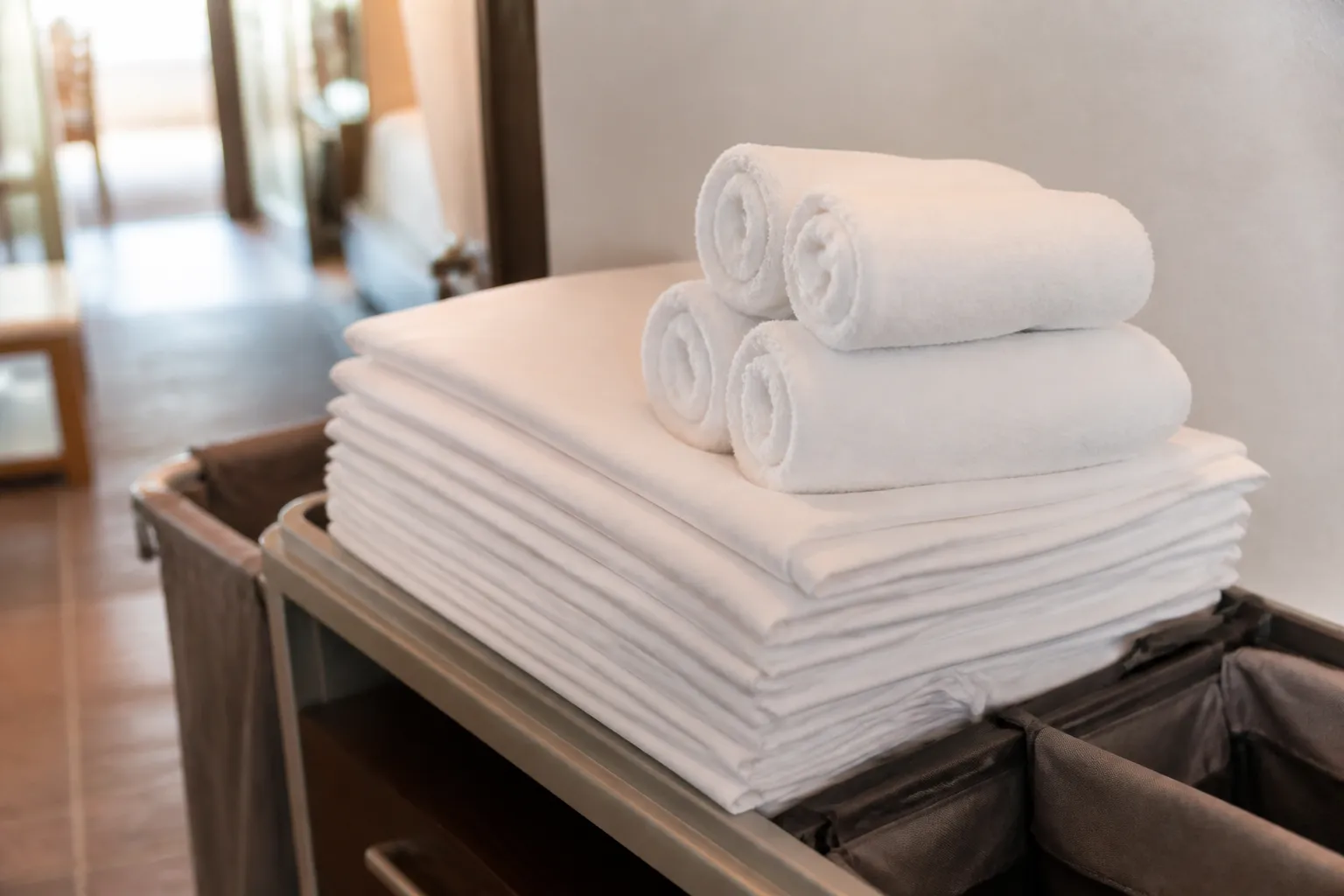
How often to change the linen in a hotel is not just a hygiene question: it affects laundry costs, turnaround times and (increasingly) how sustainable a guest perceives the property to be. It’s one of the first policies worth putting in writing, since it involves reception, housekeeping and sometimes an outside supplier too.
Contents
- The general rule
- Why changing everything every day is not a good idea
- Folding and arrangement: the details that get noticed
- Fabric and linen quality: an often underrated factor
- The housekeeper’s working kit
- Handling special guest requests
- Tracking linen changes on the floor log
- In-house or outsourced laundry: what changes for turnaround times
The general rule
For departure rooms, linen is always changed, no exceptions: sheets, pillowcases and towels are replaced at every check-out. For rooms occupied by guests staying several nights, the most common practice is to change sheets every 3-4 days and towels every 1-2 days, unless the guest asks otherwise. Some hotel chains apply slightly different rules depending on category: a 5-star property tends to still offer a daily change on explicit request, while 3-star hotels and farm stays more often use fixed intervals communicated to the guest at check-in.
Communicating the policy matters as much as the policy itself: a card left on the bed or a note in the welcome folder stops a guest from reading the absence of a daily change as a lapse, when in fact it is a stated choice by the property.
Why changing everything every day is not a good idea
Changing linen every day in every occupied room might look like a sign of care, but it has two side effects: it raises laundry costs and the property’s environmental impact, and it is almost never what the guest actually expects. Many chains have introduced “change linen on request” cards precisely to leave the choice to the guest, cutting consumption without affecting perceived quality. A mid-sized property moving from a daily change to a change every 3 days can cut laundry cycles by more than 50%, with a direct saving on water, energy and detergent, plus less wear on the fabric itself.
Folding and arrangement: the details that get noticed
How often the linen is changed matters less than how it is presented. Crisp, even folding with no visible creases signals care regardless of when the last change happened. Towel arrangement follows fixed standards too: folded and lined up on the rail or the edge of the tub, with the largest towel always at the bottom, the medium one in the middle and the face towel or washcloth on top, the layout most common in mid-to-upscale hospitality. Sheets should be folded to the same pattern across every room in the property, so any team member can tell at a glance whether a bed has been made correctly.
Fabric and linen quality: an often underrated factor
The ideal change frequency also depends on fabric quality. Heavier-weight cotton linen keeps a well-kept look for longer than a cheap blend, which tends to grey and lose its crease within just a few washes. Investing in higher-quality fabric can, in some cases, allow slightly longer change intervals without the guest noticing any drop in care, with a financial payoff over time thanks to fewer damaged items needing replacement.
The housekeeper’s working kit
To manage linen changes efficiently, every trolley needs a fixed set-up: spare sheets and pillowcases for the number of rooms on the shift plus a 10-15% safety margin, replacement towels in the three standard sizes, separate bags for used linen and bags for the load going back to the laundry. An incomplete kit is one of the most common causes of delay during a shift, because it forces the housekeeper to stop and go back to the floor storeroom at the least convenient moment.
Handling special guest requests
Detergent allergies, requests for hypoallergenic linen, more frequent changes for medical reasons or simply out of habit: these requests should be logged on the guest profile and passed to the floor team before the shift starts, not discovered on the spot. Clear communication between reception and housekeeping on these details avoids both poor service and wasted time on last-minute checks.
Tracking linen changes on the floor log
Noting on a log (even a simple sheet per floor, or a tick in the management software) when each occupied room last had a linen change avoids both forgotten changes and unnecessary ones, and is useful if a guest complaint comes in. The log is also useful for calculating real laundry consumption month by month and checking whether the stated policy is actually being followed on the ground.
In-house or outsourced laundry: what changes for turnaround times
A sustainable change frequency also depends on how the laundry is organised. A property with an in-house laundry has shorter cycles and can afford more frequent changes without piling up huge stocks of clean linen. One relying on an outsourced laundry needs to factor delivery and collection times into planning: you typically need stock for at least two or three full room cycles, so you are never left without clean linen if a delivery is delayed. This calculation needs revisiting every time the property’s occupancy rate changes, not fixed once at opening and forgotten.
Even a small property without a dedicated management office can apply the same principles with simple tools: a shared notebook or a digital reminder is enough to get the same benefits as a more sophisticated system, as long as someone actually checks it every day.
Well-organised linen management is part of the same standard we build our room cleaning service on for hotels and farm stays across Tuscany. For an assessment of your property’s laundry consumption, get in touch.