


Hotel room cleaning checklist: the 7 stages of a turnaround
Published on
5 min read
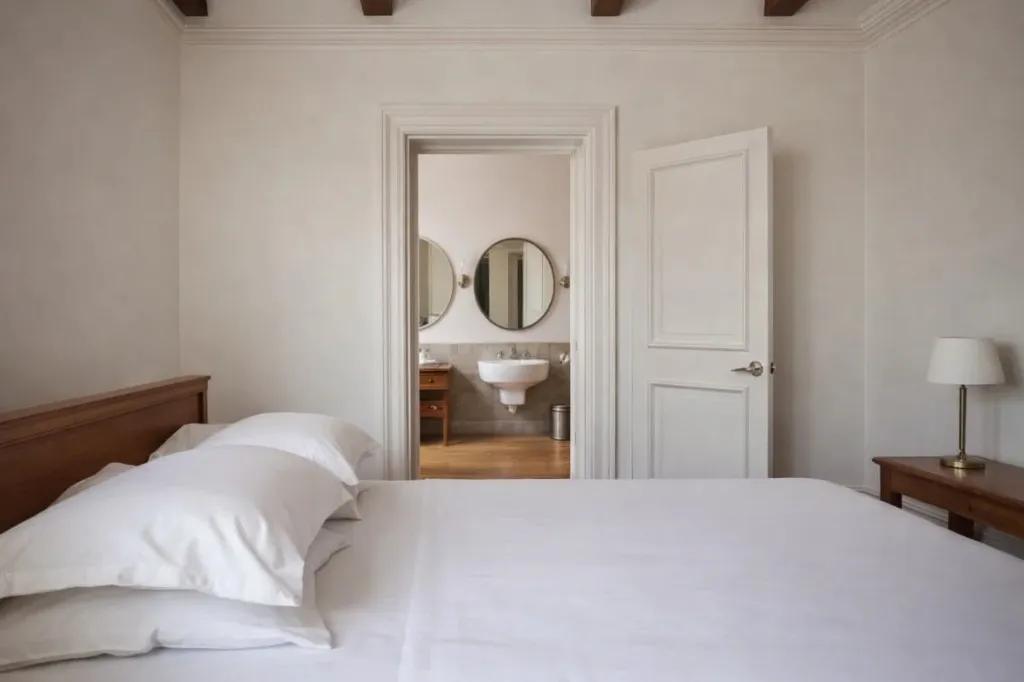
Turning around a room is not a list of tasks to be ticked off in any order: it is a sequence. Always following the same order cuts the time required, avoids going over the same surfaces twice and (above all) stops a detail the guest will notice from being forgotten in the last room of a shift.
This is the sequence our teams apply in the hotels and farm stays we work with across Tuscany.
Contents
- Airing and inspection
- Stripping: waste and used linen
- The bathroom, first
- Making the bed
- Surfaces and touch points
- Amenities check
- Floors and final check
- Adapting the sequence to suites and superior rooms
- Training the team on the sequence
- Why order matters more than speed
Airing and inspection
Before touching anything: open the windows and walk the room. This serves two purposes. First, the air changes over while the work is done, so the room is already neutral on handover, a detail that matters most in rooms kept closed during a long stay or with the air conditioning running constantly. Second, anything needing non-standard attention (a stain on a fabric, a leaking fitting, a blown bulb) is spotted straight away and reported to reception before it becomes a problem at check-in. If the room is occupied, this is also when the guest’s belongings are noted, so everything can be left exactly where it was found.
Stripping: waste and used linen
Everything comes out before any cleaning starts: bins, leftovers, bed linen and bathroom linen. Working in an already cleared room is faster and reduces the risk of cross-contamination between used linen and freshly sanitised surfaces. Bags for used linen should always be kept separate from general waste bags and never left open in the corridor while the rest of the room is turned around: it’s one of the first things an inspector, or a passing guest, will notice.
The bathroom, first
The bathroom is tackled at the start, not at the end. Products for sanitary ware and shower enclosures need contact time to actually work: applying them early means they can do their job while the bed is being made, so you come back only to rinse and dry.
The internal order runs from least to most contaminated: basin and taps, shower or bath, and the WC last, using dedicated cloths and equipment that never return to the other surfaces. Glass and mirrors are cleaned last in this stage, once residual steam has cleared, to avoid streaks that would need a second pass.
Making the bed
This is the first thing a guest looks at on entering. Clean linen, taut and crease-free, aligned pillows, mattress protector checked at every change. It is worth the time it takes: no other surface in the room communicates the property’s standard of care as quickly. Many 4- and 5-star properties also add a fixed bed styling touch (a throw, decorative cushions, a runner) following a set pattern photographed once during training and repeated identically room after room.
Surfaces and touch points
Dust from top to bottom, so any dust that falls lands on surfaces not yet treated. The points everybody touches and almost nobody notices deserve a dedicated pass:
- door and window handles
- switches and faceplates
- television remote and thermostat
- telephone, safe, minibar handle
A microfibre cloth dedicated only to these points, kept separate from the one used on furniture, cuts the risk of leaving streaks on shiny surfaces such as glass or metal, and avoids carrying product residue from one part of the room to another.
Amenities check
Bathroom amenities, courtesy items, minibar, information material, kettle and glassware. This is also the moment to verify that everything works: air conditioning, lights, sockets, Wi-Fi. A missing item or a faulty device discovered by the guest costs far more than checking it now. It’s worth keeping a small stock of common spares on the trolley (bulbs, remote batteries, kettle capsules) so a minor issue can be fixed on the spot without a trip back to the storeroom.
Floors and final check
Floors are done last, working out of the room, so you never walk back over a surface that has just been cleaned.
Then the final check, done from the doorway, standing, with the eyes of somebody entering for the first time: alignment, curtains, the smell of the room, lights off, temperature. It is a thirty-second review that catches most of the issues that would otherwise reach reception in the first hours after check-in.
Adapting the sequence to suites and superior rooms
The logic of the sequence stays the same in larger rooms, but some stages take longer and need more attention: a separate lounge adds surfaces and touch points to check, a terrace or balcony should be included in the initial airing round, a whirlpool bath needs a dedicated pass during the bathroom stage. The order of operations does not change: only the time needed to complete it, which should be estimated separately when planning shifts.
Training the team on the sequence
A written sequence is not worth much if it is not taught the same way to the whole team. The most effective method we have found is pairing every new team member with an experienced housekeeper for their first rooms, having them repeat the order of stages out loud while working, then checking the results with a dedicated quality check in the first weeks on the job. A well-internalised sequence shows up in how quickly a team recovers from a delay without skipping steps: it does not speed up any single action, it simply avoids having to repeat it.
Why order matters more than speed
A team working to a fixed sequence is faster than a team improvising, simply because it never doubles back. It is also easier to train and to audit: if a room is not up to standard, you can trace it straight back to the stage where it went wrong.
It is the principle we build our room cleaning service on for Tuscan hospitality properties: fixed teams, a shared procedure, a repeatable standard at every changeover.
Want to work out how to apply it to your property? Get in touch for a free site visit and a tailored quote.