


Hotel room sanitisation: protocol and products
Published on
5 min read
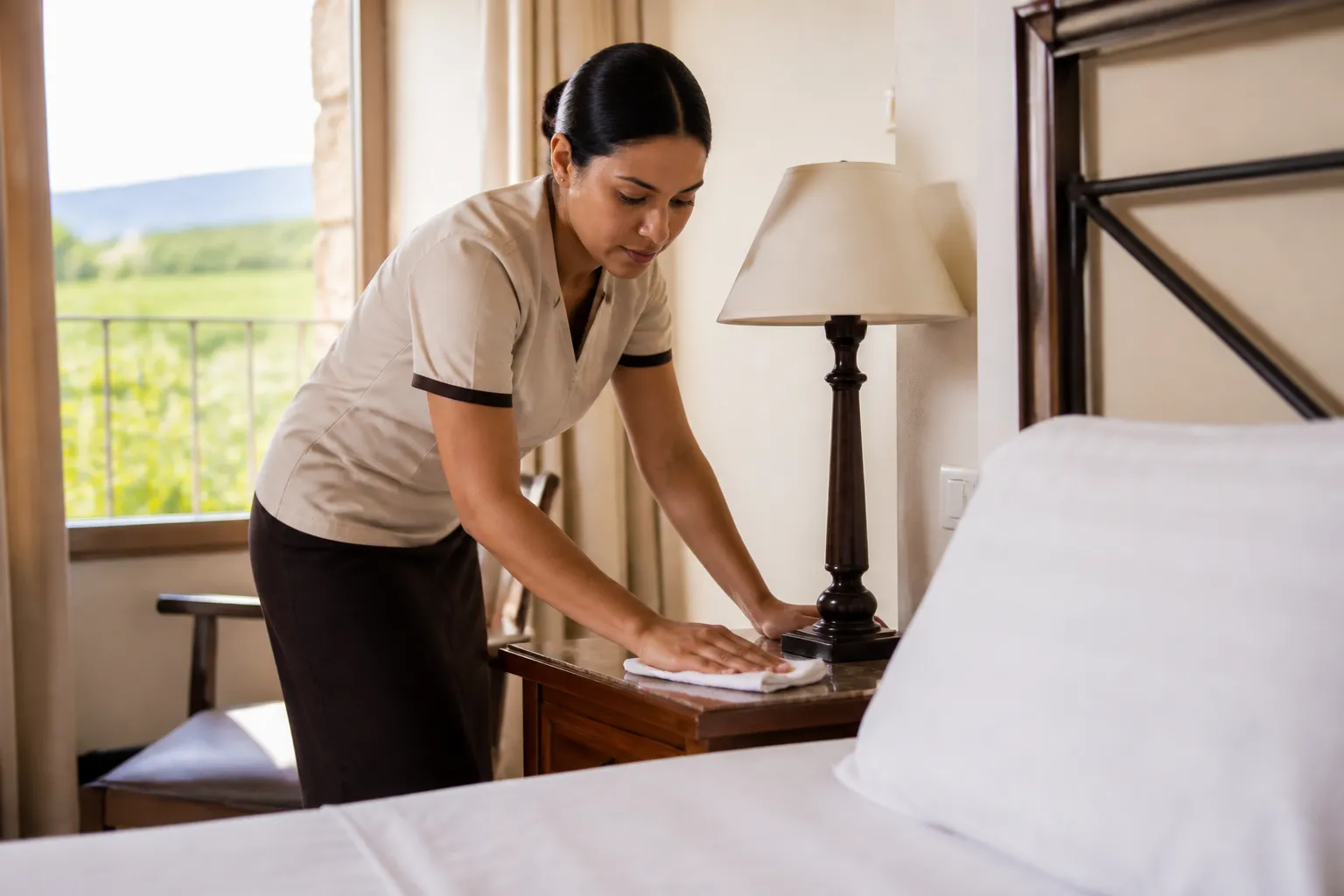
Sanitising a hotel room does not mean putting more product on the same surfaces covered by routine cleaning: it needs a dedicated sequence, products chosen according to the material being treated, and specific contact times that must be respected to actually work. Done properly, it protects both the guest and the property, and it should be built into the daily turnaround rather than treated as a separate step that’s easy to forget.
Contents
- When sanitisation is needed
- The priority surfaces
- Sanitising mattresses and pillows
- Sanitising after stays involving pets or illness
- Which products to use, in practice
- Common mistakes in room sanitisation
- Dedicated equipment for sanitisation
- Time to allow for in the work shift
- Training the team on a sequence, not a list
- Sanitisation and tourist seasonality
- Recording the job
When sanitisation is needed
Sanitisation should happen at every check-out, as part of the full turnaround, and as an extra step after a stay involving pets, an illness reported by a guest, or maintenance work that left dust or residue behind. In these extra cases the time needed should be budgeted separately when planning shifts, because it almost always takes longer than a standard sanitisation pass.
The priority surfaces
Touch points, the bathroom and hard surfaces are sanitised with products specific to each material. The most common mistake is using the same multi-purpose product on everything: some materials (marble, treated wood, certain plastics) need compatible formulations to avoid damage over time. A written list stating which product to use on which surface stops this choice being left to individual improvisation.
Sanitising mattresses and pillows
Sanitising hotel mattresses is typically done with steam treatment or specific anti-mite products, on a periodic frequency wider than the daily turnaround (usually quarterly, barring specific situations). Sanitising pillows follows the same logic, especially for properties that do not use removable pillow protectors, where direct skin-to-fabric contact makes this step even more important.
Sanitising after stays involving pets or illness
A stay involving pets calls for extra attention to rugs, fabrics and upholstery, where fur and allergens settle more deeply than on smooth surfaces. An illness reported by a guest, on the other hand, calls for assessing whether genuine disinfection is needed on top of standard sanitisation: the difference between the two levels, covered in detail in our piece on cleaning versus sanitising versus disinfecting, is exactly where it becomes operationally relevant.
Which products to use, in practice
Sanitising a hotel room needs, as a minimum: a sanitising cleaner for hard surfaces, a specific product for fabrics and mattresses, and quick-drying wipes or spray for touch points. They should always be used according to the dilution and contact time stated on the label: under-dosing means the product does not work, over-dosing means wasting product and risking residue that can irritate the skin of sensitive guests.
Common mistakes in room sanitisation
The three most frequent mistakes are: applying a sanitising product to a surface that hasn’t been cleaned first; not respecting the stated contact time, wiping the product off too soon; and reusing the same cloth on multiple surfaces without rinsing or replacing it, carrying residue from one part of the room to another. All three are fixed with targeted training, not by switching products.
Dedicated equipment for sanitisation
Beyond the products, the equipment used for sanitising should also be partly dedicated: microfibre cloths in a different colour code from those used for routine cleaning, separate sprayers to avoid cross-contamination between products, disposable gloves changed for every room during extra sanitisation work. This level of organisation needs a modest initial investment but noticeably cuts the risk of mistakes in day-to-day practice.
Time to allow for in the work shift
Thorough, correctly done sanitisation takes longer than a surface clean: it needs to be factored into turnaround time calculations, not treated as an activity that gets “added on” without affecting scheduling. Ignoring this almost always results in rushed sanitisation, which undoes the investment made in choosing the right products.
Training the team on a sequence, not a list
Sanitisation works best when it’s taught as a sequence of actions to repeat in the same order every time, not as a list of products to use at the housekeeper’s discretion. A well-trained team knows exactly at which point in the turnaround each spot needs sanitising, without having to think about it every time: it’s this automatic habit, built through repetition, that guarantees no step gets skipped when a shift gets busier than expected.
Sanitisation and tourist seasonality
During peak season, when room turnover is more frequent and the time available for each clean shrinks, the temptation to shorten or skip the sanitisation step altogether gets noticeably stronger. That’s exactly the wrong moment to do it: the more different guests occupy the same room in a short period, the more thorough sanitisation matters, not less. Planning staffing and time around this, rather than discovering it during the peak, avoids having to choose between keeping to schedule and keeping to standard, a trade-off no property should ever have to make on a busy Saturday morning in the middle of the high season, when every single room and every single minute genuinely matters to the day’s outcome.
Recording the job
Even a simple tick on a room sanitisation log helps prove, in the event of an inspection or a complaint, that the protocol was followed. It is a practice we build into our cleaning and sanitising service for hotels and farm stays across Tuscany.
Investing time in properly sanitising every room, rather than treating it as an add-on step, is one of the cheapest investments a property can make to cut complaints and negative reviews linked to perceived hygiene.
Want to review your property’s sanitisation protocol? Get in touch for a free assessment.