


Hotel sanitisation records: how to keep them
Published on
5 min read
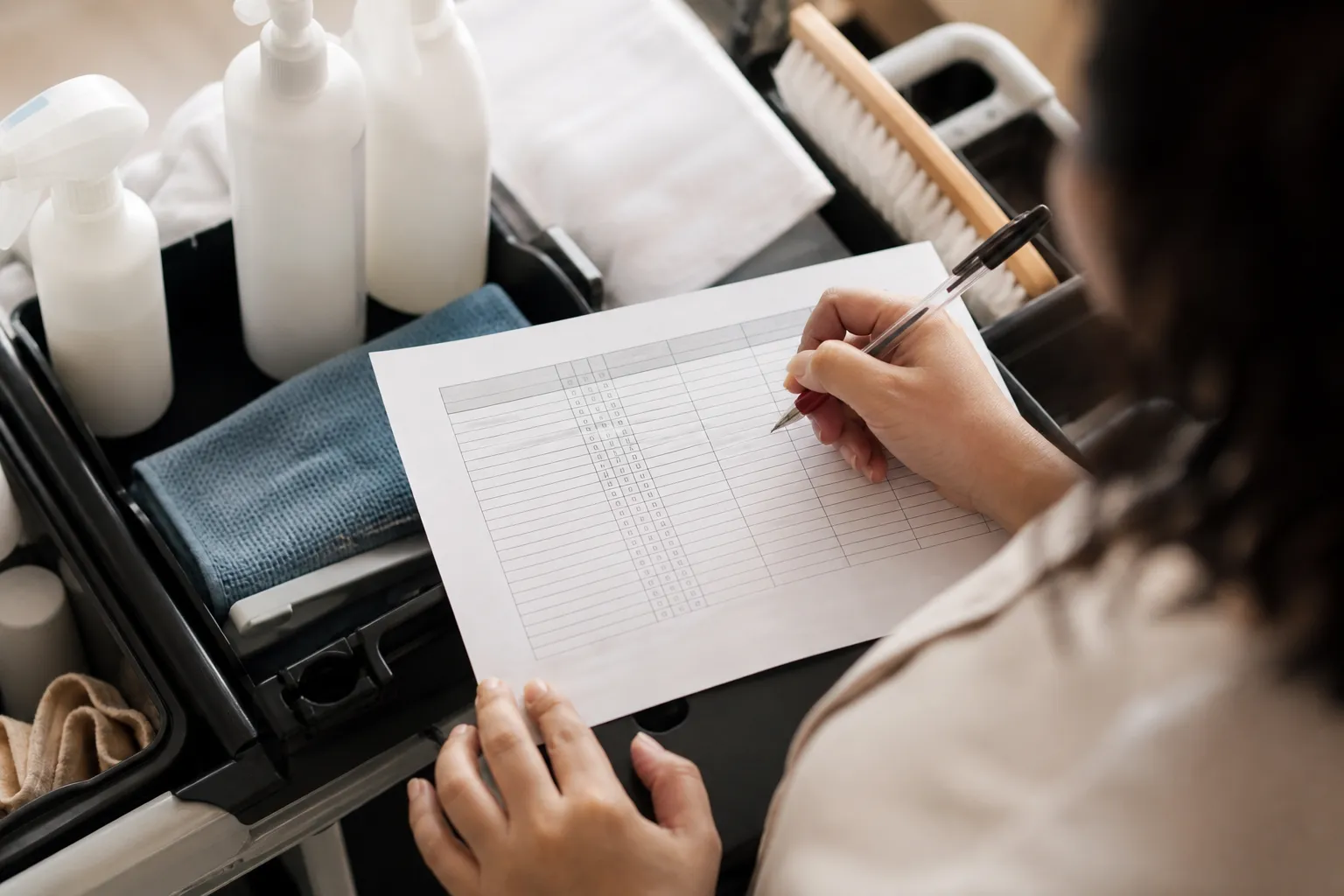
A well-kept sanitisation log is the simplest and most effective tool to prove that a property’s hygiene protocol is actually being followed, not just written down on paper and then ignored in day-to-day practice.
Contents
- What the log needs to contain
- Who fills it in, and when
- Paper or digital log
- The link with the risk assessment document
- Interference risk assessment: when cleaning is contracted out
- How long to keep the records
- An example log for a smaller property
- Common mistakes in keeping the log
- A simple log, but not an optional one
What the log needs to contain
For every job, you need to note: the area treated, the date and time, the product used, and who was responsible for the job. It does not need a complex system: even a paper form per floor, filled in consistently, is enough. It is worth adding a column for any issues found during the job (a stubborn stain, a fault, an unusual smell), so the log also becomes a useful historical record for maintenance, not just for hygiene. Some properties also add a column for time spent, useful for planning future shifts and for checking whether a particular area consistently takes longer than expected.
Who fills it in, and when
The log should be filled in by whoever actually did the job, right after doing it, not at the end of the shift from memory. A log filled in late loses credibility and is the first thing an outside inspection will question. An effective habit is to keep the form (paper or a shared tablet) directly on the housekeeping trolley, so filling it in becomes a natural part of the work sequence rather than an extra step to remember separately.
Paper or digital log
For smaller properties, a paper log organised by floor or area remains a perfectly valid solution, as long as it is filed in an orderly way. For larger properties or ones with several sanitisation points to track, an app or a simple shared digital sheet reduces the risk of lost sheets and lets you generate a report quickly in the event of a check, as well as making it easier to compare periods across the year.
The link with the risk assessment document
The risk assessment document tied to hotel cleaning identifies the specific hazards of sanitising work (chemical products, slippery surfaces, equipment) and the preventive measures adopted. The sanitisation log is the operational proof that these measures are actually applied day by day. If the risk assessment document specifies, for example, using specific gloves for a given product, the log should make it possible to verify that measure has actually been followed over time, not just written down as a policy.
Interference risk assessment: when cleaning is contracted out
When cleaning is handed to an outside supplier operating in the same spaces as in-house staff, an interference risk assessment coordinates safety measures between the two parties. It is a document separate from the sanitisation log, but closely linked to it: both exist to prove that safety is managed, not left to chance. The interference risk assessment needs updating whenever the outside supplier’s hours, spaces or working methods change substantially, not left unrevised for years.
How long to keep the records
There is no single deadline that applies to every case, but a prudent practice is to keep sanitisation records for at least two or three years, in line with the typical timeframe within which they might be requested during a check or a guest dispute. Keeping them digitally, with regular backups, avoids the risk of loss that comes with paper-only filing.
An example log for a smaller property
For a farm stay with eight rooms, a working log can simply be a weekly form with one row per room and columns for date, bathroom sanitising, touchpoint sanitising (handles, remote controls, switches) and a signature from whoever did the job. At the end of each week, the completed form gets filed into a monthly binder, so that by the end of the season the property has complete, orderly documentation without having had to manage a complex system during the busiest months.
For a larger property, the same principle applies per floor or per department, with a manager collecting and checking each staff member’s forms at the end of the shift, catching any gaps in filling them out immediately, before they turn into a problem that is hard to fix weeks later.
Common mistakes in keeping the log
The first mistake is filling in several days at once from memory, often at the end of the week, which loses the accuracy that makes the log useful. The second is using descriptions that are too generic (“cleaning done”) instead of stating precisely the area, product and person responsible, which are the details a check actually verifies. The third, more subtle mistake is keeping an accurate log but filing it in a disorganised way, so that at inspection time it takes hours to reconstruct the requested information instead of a few minutes.
A simple way to avoid these mistakes is assigning one person, even on a monthly rotation, responsibility for checking that the log is complete and consistent, rather than waiting for the problem to surface only during an outside inspection.
A simple log, but not an optional one
The value of a sanitisation log is not in how complex its format is, but in how consistently it is kept up to date. It is one of the practices we build into every cleaning and sanitising service we provide to Tuscan properties.
Want help setting up a sanitisation log for your property? Get in touch.