


Sanitising products for hospitality businesses
Published on
5 min read
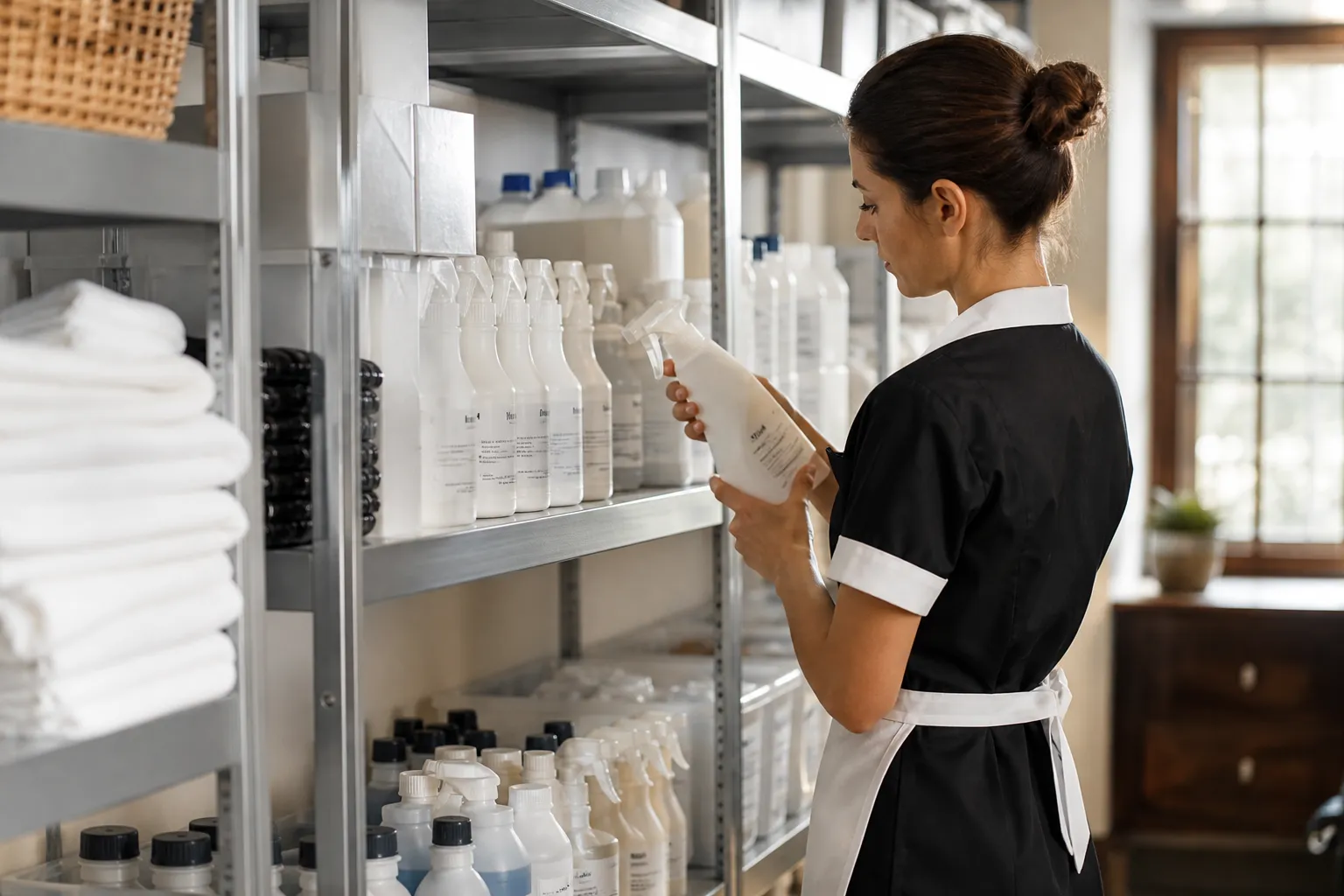
Choosing the right products to sanitise a hospitality business is not just a question of effectiveness: it affects staff safety, environmental impact and running costs in the long term, as well as how guests perceive the property when they notice the smell or residue of the products used.
Contents
- Why this choice deserves more attention than it gets
- The selection criteria
- Ozone sanitisation: when it makes sense
- Sanitising pool towels
- Eco-friendly products without losing effectiveness
- Concentrated products and dosing
- Training staff to handle chemical products safely
- Testing a product before rolling it out property-wide
- Storage and safety of chemical products
- Standardising products across different areas of the property
- Ongoing training on new products
- Choosing a supplier, not just a product
Why this choice deserves more attention than it gets
Product selection is often delegated entirely to whoever happens to place the order, without a structured review of what’s actually needed for each area of the property. Treating this as a strategic decision, revisited periodically rather than left on autopilot, prevents a property from being stuck for years with products that no longer match its real needs or the latest available options on the market.
The selection criteria
A professional sanitising product should be judged on three criteria: its declared effectiveness (referenced against a standard or certification), its compatibility with the property’s surfaces, and its safety profile for the person using it and for the guest who will later occupy the space. A fourth criterion, often underrated, is ease of use: an effective product that’s fiddly to dose correctly ends up being used badly in day-to-day practice.
Ozone sanitisation: when it makes sense
Ozone sanitisation in hotels is a useful technology for enclosed spaces that need deep treatment without chemical residue (after a case of persistent odours, for example) but it needs precise ventilation times and staff trained to use the equipment correctly. It does not replace daily cleaning: it complements it in specific cases, typically after an extended stay involving pets or following refurbishment work.
Sanitising pool towels
Hotel pool towels deserve separate treatment because they are in direct contact with skin in a humid environment, a condition that favours microbial growth. A high-temperature wash cycle with a sanitising product specific to fabrics matters far more than any treatment applied afterwards. Storage matters too: towels that are clean but left in a humid space before being handed out to guests undo part of the laundry’s work.
Eco-friendly products without losing effectiveness
Demand for low-impact products has grown a lot in recent years, but not every eco-friendly product delivers the same level of effectiveness as traditional sanitisers. It’s worth checking environmental certifications alongside declared effectiveness data, rather than assuming “natural” automatically means “effective”: the right choice balances both aspects based on the actual risk level of the area being treated.
Concentrated products and dosing
Many mistakes in the use of sanitising products come from imprecise dosing, often out of haste or habit. An automatic or pre-dosed system reduces waste and guarantees that every surface receives the correct concentration, neither too weak nor too aggressive, with savings over time that comfortably offset the initial investment in the equipment.
Training staff to handle chemical products safely
Beyond their effectiveness on surfaces, sanitising products carry risks for the people who handle them daily: skin irritation, respiratory reactions, dangerous incompatibilities if two different products are mixed by mistake. Basic training on reading safety data sheets and using personal protective equipment should be part of every new team member’s onboarding, not left to on-the-job experience.
Testing a product before rolling it out property-wide
Before replacing a product used across the whole property, it’s worth testing it in one limited area for a few weeks: checking not just its declared effectiveness but also how it performs in daily practice, how long staff need to apply it correctly, and whether it leaves visible residue once dry. Switching products without this test phase risks discovering problems only after stock has already been bought for the entire property.
Storage and safety of chemical products
Storing sanitising products also needs care: suitable temperatures, physical separation between incompatible products, and access limited to trained staff. A disorganised product store isn’t just a safety risk; it’s also a common cause of waste, when expired or damaged products are only discovered at the point of use.
Standardising products across different areas of the property
Having too many different products in use at the same time raises the risk of mistakes: cloths and bottles mixed up between areas, staff who can’t remember which product goes where, stock to manage for items that look similar but aren’t interchangeable. Cutting the number of different products down to the minimum needed, standardising them across areas with similar requirements, simplifies both training and stock management.
Ongoing training on new products
Every time a new product is introduced, even just replacing a similar one already in use, it’s worth spending a few minutes on a short refresher with the team: the product’s name, where it’s used, and what changes compared with the previous one. Skipping this step, on the assumption that “it’s basically the same”, is one of the most common causes of incorrect use in the days right after a supplier switch, when old habits are hardest to unlearn.
Choosing a supplier, not just a product
Choosing products should go hand in hand with choosing a supplier who guarantees continuity of supply, up-to-date safety data sheets and support when regulations change. It is something we take care of for the properties we work with through our cleaning and sanitising service.
A carefully considered product choice, reviewed periodically against what’s newly available on the market, is one of the investments that pays back fastest in terms of staff safety and guest-perceived quality.
Want advice on the sanitising products best suited to your property? Get in touch.