


Stay-over vs departure cleaning: what changes
Published on
5 min read
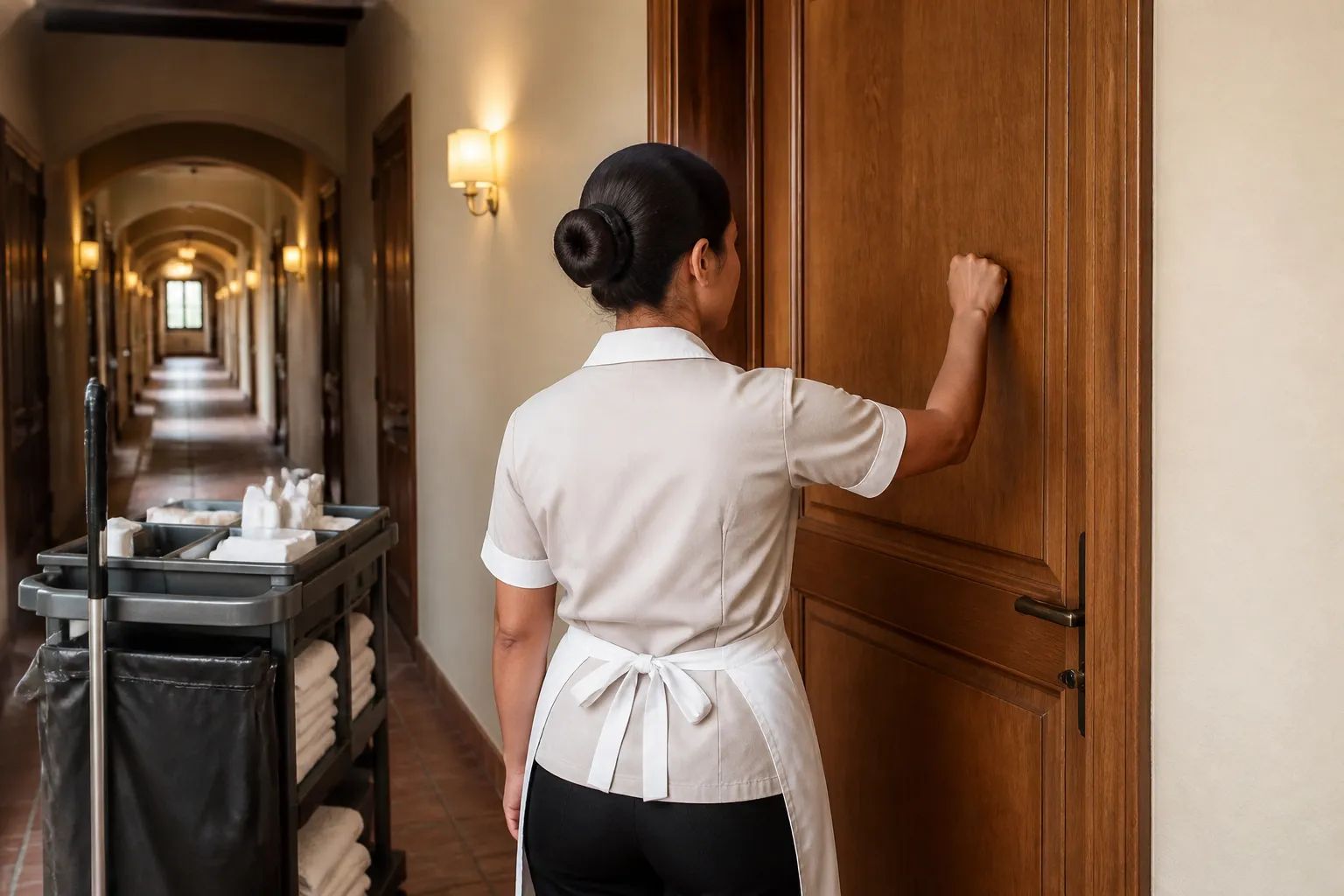
Not every room is cleaned the same way. A room occupied by a guest staying several nights needs a different approach (quieter and quicker) compared with a departure room, which has to be brought back to welcome standard for the next guest. Confusing the two, or treating them as interchangeable, is one of the most common causes of unbalanced shifts.
Contents
- Departure rooms: the full turnaround
- Occupied rooms: a lighter touch
- Cleaning a hotel room after a long stay: specific attention points
- Servicing an occupied hotel room with the guest present
- The booking system’s role in assigning the right service
- Why the distinction matters for shift planning
- Training the team to recognise the type of service on sight
- Signs not to ignore in either type of service
- One standard, two speeds
Departure rooms: the full turnaround
After a check-out, everything starts from scratch: all the linen is changed, every surface is sanitised, amenities are checked and restocked, and a full final check is carried out before the room is declared ready. Cleaning a hotel room after check-out is the longest, most demanding job of the day, especially after a long stay: the longer a guest stays, the more personal items, signs of use and small marks accumulate. This is also when you find out whether the guest has left anything behind, to be handled under the property’s lost-property procedure before the rest of the turnaround continues.
Occupied rooms: a lighter touch
For an occupied room the goal is different: keep it tidy and hygienic without disturbing the guest’s belongings. Bed made, bathroom sanitised, bins emptied, towels replaced according to the property’s policy, surfaces dusted. Nothing is moved unless strictly necessary, and every guest item stays exactly where it was found: even a book left open at a certain page or a charger plugged into a specific socket should go back exactly as it was.
Cleaning a hotel room after a long stay: specific attention points
After five nights or more in the same room, some tasks that would normally only happen at departure need to be brought forward: a closer check of the wardrobe and drawers, attention to corners that a short stay never touches, particular care with residual odours that build up over time. Linen changes, too, tend to follow tighter cycles in these cases than during a one- or two-night stay, to stop the accumulated days from making the room feel less fresh right towards the end of the stay, when the risk of a negative review is highest.
Servicing an occupied hotel room with the guest present
Sometimes a guest asks for the room to be serviced while they are still in it. In these cases the rules change: always knock, introduce yourself, ask permission to enter and work as quickly and discreetly as possible, avoiding opening wardrobes or drawers unless explicitly asked to. It is a situation that calls for tact more than speed: it is better to complete only the essential tasks (bathroom, bins, bath linen) and offer to come back later for the rest, rather than insisting on completing the full standard service with the guest in the room.
The booking system’s role in assigning the right service
Most hotel management software automatically flags, room by room, whether a service is a departure or an ongoing stay, cross-referencing check-in and check-out data. This automation is useful but not foolproof: a late check-out, a last-minute extension or a room change can leave the system out of step with reality. For this reason the floor manager should always have a quick way to verify doubtful cases before assigning a room to the team, rather than blindly trusting the automatic flag.
Why the distinction matters for shift planning
Assigning shifts without distinguishing between occupied and departure rooms almost always leads to wrong estimates: a team with too many departures on the same shift risks running over time, one with too many occupied rooms has slack that could be used elsewhere. The daily plan should always show, for every room, the type of service required before the shift starts, so the workload is balanced realistically across teams and not just by the number of rooms assigned.
Training the team to recognise the type of service on sight
A common mistake in newer properties is to rely only on the management software to flag the type of cleaning needed, without training the team to recognise it on the ground. A well-trained housekeeper can read the signs in a room (luggage still there, personal items scattered around, linen used just the day before) and adapt the service even when the system has not yet updated the booking status, for example after a late check-out or a date error.
Signs not to ignore in either type of service
Regardless of the type of cleaning, some signs should always be reported and never dismissed to “save time”: an unusual smell, a stain that seems to have spread since the last check, a damaged item belonging to the property. In an occupied room these signs should be reported to reception discreetly, without involving the guest directly unless necessary; in a departure room they should be documented before the room is declared ready, to handle any liability against the security deposit.
One standard, two speeds
The difference between the two types of service is not in the quality of the result, which stays identical, but in the amount of work needed to reach it. It is a principle we apply in our room cleaning service for hotels and non-hotel accommodation across Tuscany.
Even a small property with a single housekeeper benefits from this distinction: simply noting each morning, next to the room number, whether it’s a departure or an ongoing stay makes it much easier to plan the day’s workflow.
Want help planning your shifts around the two types of service? Get in touch for a free assessment.